 Add to Chrome
 Add to Firefox
 Add to Edge
QVGGT: Post-Training Quantized Visual Geometry Grounded Transformer
May 29, 2026
Estimating 3D attributes directly from images has advanced rapidly with the Visual Geometry Grounded Transformer (VGGT), which predicts camera parameters, depth maps, and point clouds in a single forward pass. However, its 1.2B-parameter scale severely limits deployment on resource-constrained platforms such as UAVs and mobile AR devices. To address this limitation, we introduce QVGGT, a tailored quantization framework designed to compress VGGT. Our approach starts from the observation that transformer blocks within VGGT exhibit heterogeneous sensitivity to quantization. We thus analyze per-block quantization sensitivity and propose a selective mixed-precision strategy that allocates higher precision to the most fragile transformer blocks. To address the amplification of quantization error caused by high-variance camera and register tokens, we further introduce token filtering with camera information compensation, which removes these outliers from activation calibration and restores their geometric cues using a PCA-derived global compensation token. Finally, we develop a task-aware scale search mechanism that evaluates candidate quantization scales not only through layer reconstruction but also through multi-head supervision and cross-head geometric consistency among camera poses, depth maps, and point maps. Extensive experiments on multiple geometry perception benchmarks demonstrate that QVGGT achieves near-lossless W4A16 quantization, preserving the accuracy of all 3D prediction heads while delivering 3$\sim$4.9$\times$ memory reduction and up to 2.8$\times$ real hardware speedup over FP32. Our approach makes high-fidelity 3D perception feasible on edge devices, enabling practical deployment of feed-forward 3D reconstruction models in real-world constrained environments.

EarlyTom: Early Token Compression Completes Fast Video Understanding
May 28, 2026Video large language models (Video-LLMs) have demonstrated strong capabilities in video understanding tasks. However, their practical deployment is still hindered by the inefficiency introduced by processing massive amounts of visual tokens. Although recent approaches achieve extremely low token retention ratios while maintaining accuracy comparable to full-token baselines, most of them perform compression only at the late stage of prefilling, leaving the efficiency of the vision encoder unoptimized. In this paper, we first show that vision encoding contributes a large portion to the time-to-first-token (TTFT). Therefore, instead of compressing visual tokens only after the vision encoder, performing compression inside the encoder still leaves substantial room for exploration. Based on this insight, we propose EarlyTom, a training-free token compression framework that performs early-stage visual token compression inside the vision encoder, enabling significantly better TTFT reduction and higher throughput. In addition, we introduce a decoupled spatial token selection strategy that improves the overall compression effectiveness. EarlyTom reduces TTFT by up to 2.65x and FLOPs by up to 61% on a single NVIDIA A100 GPU for the LLaVA-OneVision-7B model, while maintaining accuracy comparable to the full-token baseline. These improvements substantially enhance the practicality of deploying Video-LLMs in real-world production scenarios.
LVOmniBench: Pioneering Long Audio-Video Understanding Evaluation for Omnimodal LLMs
Mar 19, 2026Recent advancements in omnimodal large language models (OmniLLMs) have significantly improved the comprehension of audio and video inputs. However, current evaluations primarily focus on short audio and video clips ranging from 10 seconds to 5 minutes, failing to reflect the demands of real-world applications, where videos typically run for tens of minutes. To address this critical gap, we introduce LVOmniBench, a new benchmark designed specifically for the cross-modal comprehension of long-form audio and video. This dataset comprises high-quality videos sourced from open platforms that feature rich audio-visual dynamics. Through rigorous manual selection and annotation, LVOmniBench comprises 275 videos, ranging in duration from 10 to 90 minutes, and 1,014 question-answer (QA) pairs. LVOmniBench aims to rigorously evaluate the capabilities of OmniLLMs across domains, including long-term memory, temporal localization, fine-grained understanding, and multimodal perception. Our extensive evaluation reveals that current OmniLLMs encounter significant challenges when processing extended audio-visual inputs. Open-source models generally achieve accuracies below 35%, whereas the Gemini 3 Pro reaches a peak accuracy of approximately 65%. We anticipate that this dataset, along with our empirical findings, will stimulate further research and the development of advanced models capable of resolving complex cross-modal understanding problems within long-form audio-visual contexts.
Can Large Language Models Logically Predict Myocardial Infarction? Evaluation based on UK Biobank Cohort
Sep 22, 2024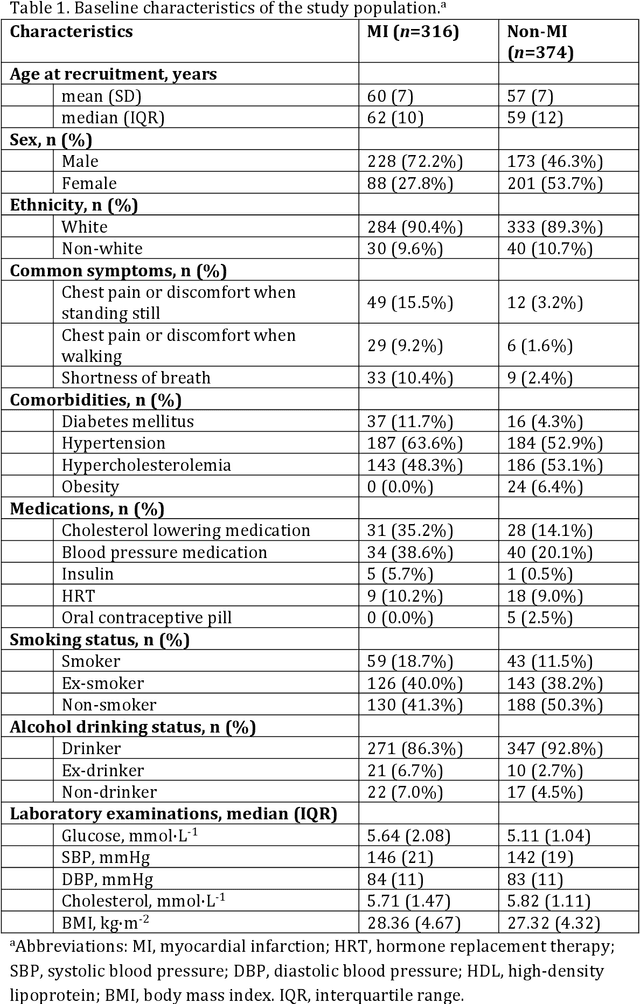
Background: Large language models (LLMs) have seen extraordinary advances with applications in clinical decision support. However, high-quality evidence is urgently needed on the potential and limitation of LLMs in providing accurate clinical decisions based on real-world medical data. Objective: To evaluate quantitatively whether universal state-of-the-art LLMs (ChatGPT and GPT-4) can predict the incidence risk of myocardial infarction (MI) with logical inference, and to further make comparison between various models to assess the performance of LLMs comprehensively. Methods: In this retrospective cohort study, 482,310 participants recruited from 2006 to 2010 were initially included in UK Biobank database and later on resampled into a final cohort of 690 participants. For each participant, tabular data of the risk factors of MI were transformed into standardized textual descriptions for ChatGPT recognition. Responses were generated by asking ChatGPT to select a score ranging from 0 to 10 representing the risk. Chain of Thought (CoT) questioning was used to evaluate whether LLMs make prediction logically. The predictive performance of ChatGPT was compared with published medical indices, traditional machine learning models and other large language models. Conclusions: Current LLMs are not ready to be applied in clinical medicine fields. Future medical LLMs are suggested to be expert in medical domain knowledge to understand both natural languages and quantified medical data, and further make logical inferences.